
The government is focusing on building with wood
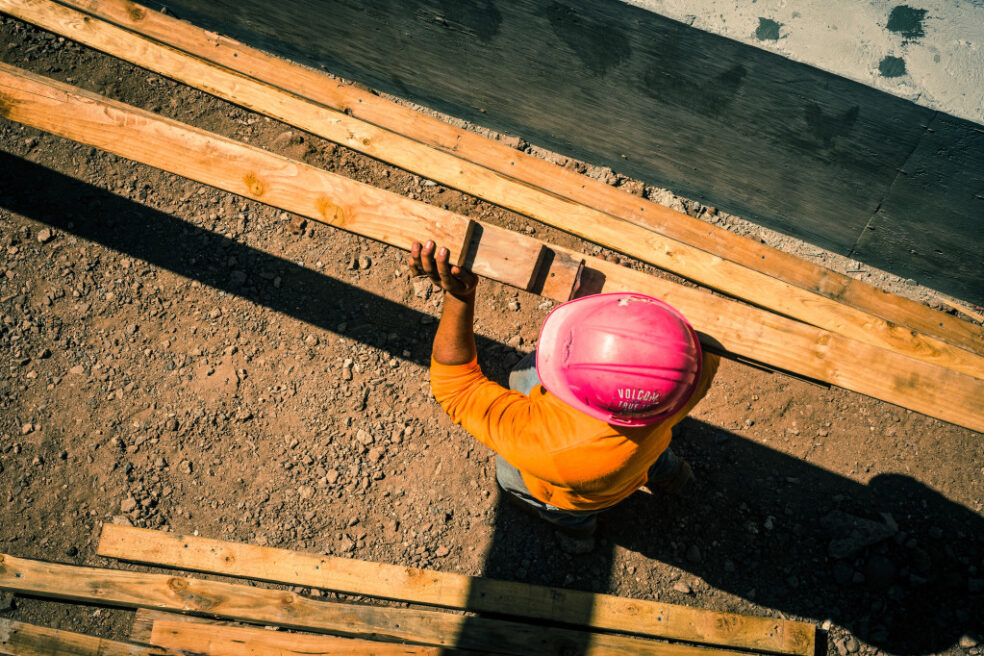
To protect the environment and make construction more climate-friendly, the state construction ministers intend to facilitate the use of wood in building and amend building regulations accordingly. The politicians reached this decision last September at the conclusion of their autumn conference in Norderstedt near Hamburg.
Several cities and municipalities are also embracing this goal: "We need to store CO2 in buildings instead of releasing it into the air," explains Tübingen's Green Party mayor, Boris Palmer, explaining why he wants to require developers in Tübingen to use wood in their construction by 2030. Concrete and steel should be largely avoided for the sake of the environment: "Concrete is extremely harmful to the climate, very energy-intensive, and therefore we must use alternative materials," says Palmer. While the production of one cubic meter of brick consumes around 138 kilograms of greenhouse gases, wood binds these harmful greenhouse gases from the atmosphere and can thus make a crucial contribution to climate protection. A joint study with Ruhr University Bochum and the Thünen Institute in Hamburg shows that a total of 42 million tons of harmful greenhouse gases could be saved by 2030 through the increased use of wood as a building material. Hamburg's Senator for Urban Development, Dorothee Stapelfeldt (SPD), is particularly focused on the expansion and addition of stories to buildings as an instrument for densifying existing urban development and brings further advantageous aspects of building with wood into play, namely the fast and cost-saving assembly on the construction site through the precise prefabrication of the components in the hall: "With sustainable management, wood is not only a particularly environmentally friendly building material, but also enables faster and more cost-effective solutions for many construction tasks," the Senator emphasizes.
Increasingly popular for homeownership
As a building material, wood has enjoyed increasing popularity among private builders for years: According to the Federal Statistical Office, one in five of the approximately 108,000 residential buildings constructed in Germany in 2018 was made of wood. Over the past ten years, timber house construction has increased by almost 50 percent. According to medical studies, living in a solid wood house has a positive effect on health; the natural material reduces stress symptoms and creates a pleasant, healthy living environment. In addition to solid log construction, timber frame and panel construction are also in demand. Thanks to the diverse design possibilities of modern timber frame construction, timber construction is increasingly finding its way into urban environments and is used, for example, in commercial and industrial buildings, public buildings such as museums, and sports halls.
Building high with wood.
Construction is increasingly moving upwards: According to a decision by the state building ministers, the so-called model building code is to be amended to allow the use of wood as a building material up to the "high-rise limit" of 21 meters. Germany's tallest wooden building, standing at an impressive 34 meters and clad in aluminum, was a star attraction at this year's Federal Garden Show in Heilbronn. To make the use of wood in high-rise construction more attractive, the state building ministers intend to relax existing fire safety regulations. Currently, the model building code, for example, prevents the construction of wooden high-rises. Schleswig-Holstein's Interior Minister, Hans-Joachim Grote, announced that wood can be used as a building material in place of fire-resistant components, provided that additional fire barriers are installed and escape routes continue to be made of non-combustible materials.
Foresters have concerns
The forestry sector is reacting with caution to the paradigm shift in construction policy. Experts like forestry graduate Lutz Fähser caution that the demand for wood must not increase disproportionately to growth. Currently, just over half of the approximately 120 million cubic meters of wood that grow annually in German forests is harvested. Fähser urges a change of thinking: "At present, we are harvesting Germany's forests far too intensively and far too early. If we want to have long-lasting products, timber beams, and timber construction in the future, then we must allow the forests to grow denser and the trees to become thicker and older."
Sources: sueddeutsche.de, stuttgarter-zeitung.de, tagesschau.de, ndr.de, schoener-wohnen.de, holzbauwelt.de, proholzbw.de, wohnglück.de
About the author

Harry Mohr
Real estate agent (Chamber of Industry and Commerce)Harry Mohr, author of this article