
Heat waves and heavy rain
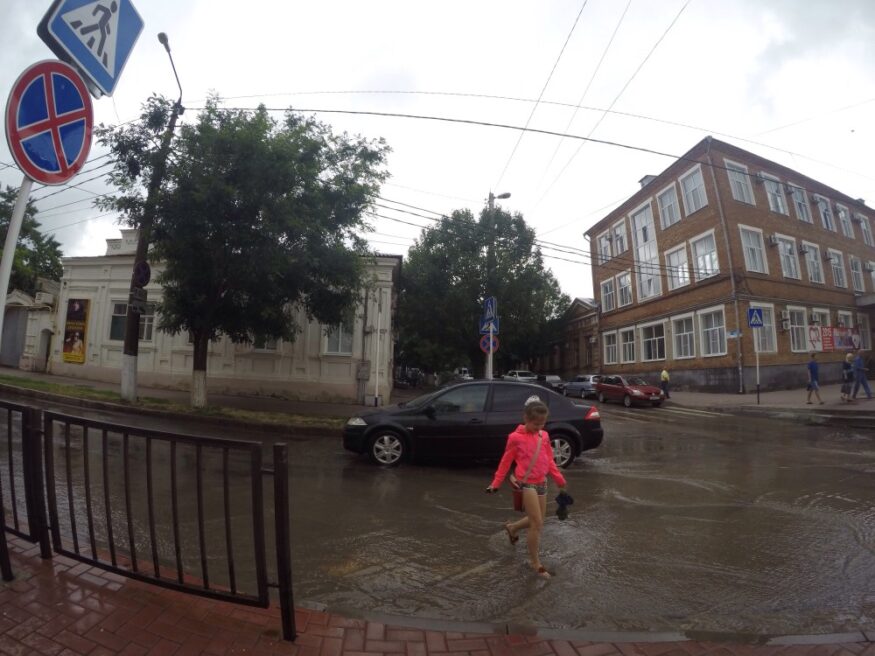
Climate change poses a major challenge to urban planning. "In the future, we will probably have to live with average temperatures five to ten degrees higher in densely built-up metropolises during the summer," predict experts such as the world-renowned climate engineer Matthias Schuler.
The number of tropical nights with temperatures above 20 degrees Celsius will also increase significantly. This particularly affects the elderly and those with weakened immune systems; according to official figures, over 1,000 people died from heat-related causes in Germany during the record-breaking summer of 2018.
Central European cities will develop a Mediterranean climate – unfortunately without the cooling sea breeze. "We are now using concepts for European cities that we originally developed for Arab desert states," explains Matthias Schuler. For example, by 2030, Paris plans to have shading systems for its major avenues that can be removed at night to allow the accumulated heat to escape into the cool night sky.
According to researchers, the German capital, Berlin, could be as hot as the Australian city of Canberra by 2050. The culprit is the urban heat island effect: facades, roofs, and sealed surfaces such as streets, sidewalks, and parking lots heat up due to solar radiation and retain the heat. Building blocks prevent ventilation and (nighttime) cooling.
Infill development and greening
The antidote to heat stress and flooding from heavy rain is to bring back what we have increasingly banished from cities: nature. But green spaces require room, and given the continued influx of people into metropolitan areas (according to international studies, around 30 percent of the world's population will live there by 2030), large cities are under pressure to create housing. "Infill development" is the buzzword: instead of designating new building areas, inner-city buildings are being extended and expanded, brownfield sites and even courtyards are being built upon. But how much density can the climate tolerate?
“Increased density and more green spaces are not necessarily mutually exclusive,” explains Berlin architect Friedrich von Borries, who develops greening concepts for major cities like Frankfurt. Existing potential, such as cemeteries, schoolyards, and sports fields, should be utilized more effectively as green oases. Further urban planning measures to combat the heat include: plenty of shade-providing trees, light-colored facades, evaporative cooling from water features, as well as ventilation corridors and artificial cold air corridors.
The city is growing upwards.
Instead of building horizontally, additional living space should be created vertically. This was the conclusion of a research project conducted by the city of Karlsruhe. Consequently, existing buildings were extended upwards and single-story outbuildings were demolished to create unsealed open space. Where more rainwater can seep into the ground, the sewers are relieved of pressure and the city center is protected from flooding.
Greenery is also increasingly growing vertically: Architects and urban planners are relying on green roofs and facades to create a better microclimate. Plants bind CO2 and particulate matter, cool the air, and increase humidity. A famous example of vertical greenery, meaning greenery growing up the sides of buildings, is the Bosco Verticale in Milan. This vertical forest, consisting of 20,000 plants and designed by Stefano Boeri, received the International High-Rise Award in 2014.
Green roof strategies and new facade systems.
More and more German and European cities are taking advancing climate change into account in their planning. Hamburg, for example, has developed a green roof strategy, while the capital, Berlin, is spending €2.7 million on greening its roofs. The Federal Ministry of Education and Research is funding the "HeatResilientCity" project, which aims to demonstrate how residential buildings and open spaces can be designed to ensure that urban life remains comfortable even during prolonged heat waves.
In Aachen, architects, textile, environmental, electrical, and mechanical engineers are conducting interdisciplinary research on new facade systems, such as textile building envelopes, which significantly reduce cooling energy requirements. An anti-smog facade is equipped with a photocatalytic coating and filters pollutants such as nitrogen oxides and fine dust particles from the air.
"We must be CO2-free by 2050." "We must be CO2-free by the middle of the century. There is no alternative for our world," warns Matthias Kopp of WWF Germany. Urban development plays a crucial role in this, as around a third of CO2 emissions and almost 35 percent of Germany's energy needs are attributable to the building sector. In addition to new construction and densification, the renovation of older existing buildings is also essential, currently accounting for less than one percent of such renovations in Germany.
According to the UN climate report, consistent thermal insulation of building facades offers an opportunity to limit global climate change. This is because, alongside the transport sector, building heating and air conditioning still consume the largest amounts of energy.
Climate protection is therefore also a responsibility of individual building owners and homeowners. Those who optimally insulate their building envelope not only make an important contribution but also reduce their ongoing operating costs.
Sources: bbsr.bund.de (Federal Institute for Research on Building, Urban Affairs and Spatial Development), haus.de, buga2019.de, haufe.de, faz.net, zeit.de, welt.de, sto.de, globalmagazin.com, swr.de, lokale-mm.de, tagesspiegel.de, fassadengrün.de, deutschlandfunk.de, co2online.de
About the author

Harry Mohr
Real estate agent (Chamber of Industry and Commerce)Harry Mohr, author of this article